 A Lean Journey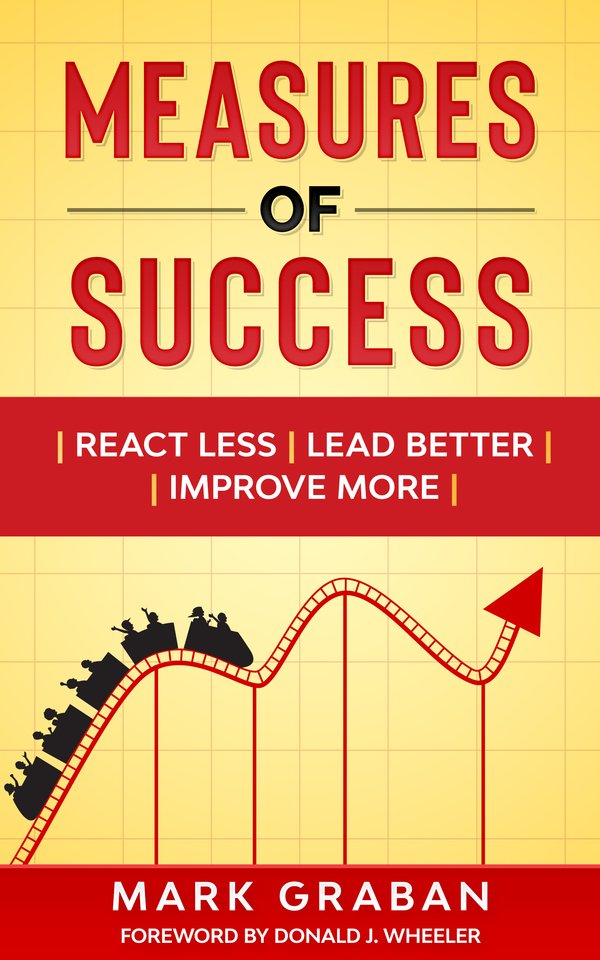
Organizations depend on metrics for their business. Question is, are they helping people do the right things? Or, encouraging them to overreact to every uptick, downturn, and change?
Mark Graban, author of, Measures of Success, shows a better way to chart and manage your metrics, in any organization or setting. For your business processes and activities, you need to know what’s working, what’s not, and what to change. And why. Then, you can determine what to stop doing, what to start doing, what to keep doing.
I recently had the pleasure of sitting down with Mark Graban and discussing his latest book Measures of Success. Here’s a little bit from the Q&A.
Q: Tell us a little bit about yourself Mark. Where did you gain your expertise?
Mark: I
don’t know if I would claim “expertise” as much as I’d point to about 25 years
of practice, formal learning and study opportunities, and learning through
experience.
I started
my career in manufacturing before moving primarily into healthcare in 2005. As
an Industrial Engineer, I had some exposure to the “just in time” aspect of
Lean as an undergrad, but really didn’t learn about Lean as a people system
until I was in the working world. During a rocky and interesting two years at
General Motors, I worked under a very traditional plant manager and then under
a different plant manager who was one of the original GM people who was sent to
NUMMI to learn from Toyota. Between him and other mentors (people GM had hired
in from Nissan and also from Toyota suppliers), those were some very formative
years.
Writing
a book or being willing to get up and talk on a stage creates the risk that you
get labeled an “expert.” I still very much consider myself a student of Lean
and I try to keep learning, challenging myself, and improving.
When
it comes to the topics that I cover in Measures
of Success, I was very fortunate to get exposed to the work of W. Edwards
Deming and Donald J. Wheeler while I was still in college. I’ve read Wheeler’s
books on Statistical Process Control and have, likewise, practiced using and
teaching these methods over the past 20+ years. I was also able to take
Wheeler’s four-day deep dive workshop, which was very helpful. A few years ago,
I wrote about how Wheeler’s Understanding Variation book was so
important to me. I was honored that Dr. Wheeler agreed to write the foreword
for my book.
Q: Why was this book important for you to write?
Mark:Measures of Success was
something I felt driven to write because I kept running across organizations
making the same preventable mistakes in the context of Lean daily management. For
one, on a project level, I see Lean or Six Sigma projects claiming “success”
from a handful of “after” data points. Or, sometimes, it’s a simple before and
after comparison of two averages or a historical average and a single
post-change data point. These comparisons can be misleading if the apparent
improvement in the metric is within the realm of routine variation – we could
call that “noise’ or point out that a metric is perhaps just fluctuating around
an average. When we claim improvement victory off of a data point that’s not
significantly better (or performance that’s sustained at a better average), we
only hamper our improvement efforts.
Another
opportunity for improvement is the way in which ongoing metrics are being
displayed and responded to… and these are not just healthcare management
issues. I’ve seen these same problems in manufacturing, software companies, and
now healthcare, which is why I wrote this as a broader management book and not just
a healthcare book, like my previous titles. But back to the point, when metrics
are posted in a way that emphasizes “red / green” comparisons to a goal or
target, leaders get caught in an overly-reactive cycle of getting too excited
or too upset about every change in a metric. Or, they react to the wrong things
(a metric that becomes red) instead of reacting to more meaningful, more
statistically significant changes in the metric. Even if people don’t want to
read my book, I have a number of blog post case studies about a
better method that is the core of my book: “Process Behavior Charts.”
The
subtitle of the book captures, I think, the core message of Measures of Success – when we react less
and lead better, we can improve more.
I
also felt compelled to write this book because I feel fortunate to have been
exposed to Wheeler’s methods. I’d guess 95% of Lean practitioners and 99% of
leaders haven’t been exposed to these methods. We shouldn’t blame people for
not using a method they’ve never been taught. We should challenge “the way
we’ve always done things” that that includes the we way we’ve always done
metrics or the way we’ve always done Lean management.
Q: What message or key points do you hope the reader takes away for your book?
Mark: The
core message is to use Process Behavior Charts on your performance metrics.
These charts will allow you to make better decisions. Knowing when to react and
when to step back and improve more systematically is a very helpful thing to
learn. Process Behavior Charts are Wheeler’s term for what has been called
“Control Charts” or “Statistical Process Control Charts.” To those with deeper
statistical knowledge, Process Behavior Charts are “Control Charts for
Individuals” or “XmR Charts” (since the full methodology calls for plotting the
data, “X”, and creating a second companion chart of the “moving ranges,” or the
change between each two successive data points). With the X Chart, we calculate
and plot three additional lines – the average and the “lower and upper natural
process limits” (aka “control limits”). The limits are basically plus and minus
three sigma around the average. The limits, combined with three simple rules,
help us find “signals” – indicators that something has changed in the
underlying system that generates the metrics.
But
beyond the statistical methods (that aren’t that complicated), this is really a
book about managing better. The Process Behavior Chart methodology is something
that I’d hope to see used in the context of local metrics (on “huddle boards,”
for example) and high-level executive methods (on “strategy deployment walls”).
People who have read the book say they’ve gained great insights from the
Process Behavior Charts they’ve created. Instead of wasting time reacting to or
explaining every up and down in a metric, they can better prioritize their
limited time around reacting to signals… and they can, when needed, step back
and use a more systematic problem solving approach (like an A3) to improve a
system in a less reactive way.
Q: What advice would you offer someone who wants to make better decisions with
data?
Mark: The
core advice is found in the ten “key points” that I
share throughout the book. My first piece of advice would be to stop comparing
just two data points to each other. As somebody told me, “Our organization is
data driven, but we need more than two data points.” Another bit of advice is to
stop looking at lists or tables of numbers. It’s much easier to see the routine
variation and any trends by creating a simple run chart (aka a “line chart” in
Excel) and looking at a historical context of at least a dozen data points
(which means not starting each year with a blank chart, by the
way). Better yet would be to use the use of Process Behavior Charts, because
the simple math and rules mean that we don’t have to guess about the appearance
of signals and trends. Again, when we stop reacting to all of the noise, we
have more time for real improvement.
One
piece of advice, as I discuss in Chapter 9 of the book, is to start small… to
take a Kaizen approach to the testing and adoption of Process Behavior Charts
in your organization. Instead of training everybody on a tool and pushing them
to use it, think about effective change management tactics, which start with
helping people realize that there is a need for change and an opportunity to do
things better. But, old habits die hard and it’s difficult to effect change
when people are comfortable with the way they’ve always managed.
Q: What’s in store for you next? What’s the next project or activity?
Mark: While
I continue doing “Lean healthcare” work, I have increasingly started doing work
related to Kaizen and Process Behavior Charts in other industries. Teaching and
coaching people on continuous improvement in a biotech lab or office setting
isn’t really that different than being in a hospital (with the exception of
patients not being present) – you’ve highly skilled and very motivated people
who are often stuck in a system that’s more difficult and less effective than
it could be. The same could be said about smart, motivated managers who are
hampered by management methods that are more time consuming and less effective
than they could be.
I
am still working hard to open people’s eyes to Process Behavior Charts and the
methodology there, which includes more writing, speaking, workshops, and
coaching. I’m still involved with KaiNexus, a software
company that helps spread continuous improvement in organizations in many
industries. I am fortunate to have lots of varied, interesting things to do and
various creative outlets… but beyond keeping busy, I more importantly want to
make a difference.









Leave a Comment
Your email address will not be published. Required fields are marked with *