 A Lean Journey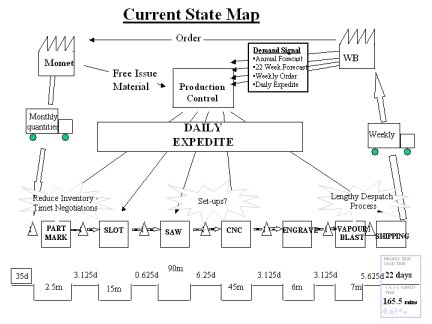
A
reader who recently watched “The Secrets to Creating an Effective Value StreamMap Webinar” asked when is okay to skip the current state map.
A
value-stream map is a visual depiction of the flow of materials and information
that provide the customer with a product or service. It also describes the lead
time of various operations and can be used as a starting point for analyzing
necessary activities and the amount of waste in the value stream. A current
state value-stream map depicts the current situation as is. A future state
value-stream map depicts what the value stream should look like after planned
improvements have been implemented. Value-stream mapping is a useful tool for
grasping the current situation and for planning improvements.
value-stream map is a visual depiction of the flow of materials and information
that provide the customer with a product or service. It also describes the lead
time of various operations and can be used as a starting point for analyzing
necessary activities and the amount of waste in the value stream. A current
state value-stream map depicts the current situation as is. A future state
value-stream map depicts what the value stream should look like after planned
improvements have been implemented. Value-stream mapping is a useful tool for
grasping the current situation and for planning improvements.
There
is a tendency to skip mapping the current state and go directly to the future
state map. But if we don’t understand the current process, we can’t really make
intelligent decisions about how the future current state might or should look.
A lot of companies want to skip the development of the current state map and
get right into brainstorming ideas for improvement. We must reduce this
impulse.
is a tendency to skip mapping the current state and go directly to the future
state map. But if we don’t understand the current process, we can’t really make
intelligent decisions about how the future current state might or should look.
A lot of companies want to skip the development of the current state map and
get right into brainstorming ideas for improvement. We must reduce this
impulse.
Skipping
the current state map is like building a house without surveying the land or visiting
the site. Doing so can lead to a home that
can’t be built and an upset homeowner.
the current state map is like building a house without surveying the land or visiting
the site. Doing so can lead to a home that
can’t be built and an upset homeowner.
The
key to creating an excellent current state values stream map is to document
what you actually see with your own eyes. We are not interested in how the
process is supposed to work, or was designed to work. Always collect
current-state information while walking the actual process to understand the
real flow. You will uncover more going to the Gemba.
key to creating an excellent current state values stream map is to document
what you actually see with your own eyes. We are not interested in how the
process is supposed to work, or was designed to work. Always collect
current-state information while walking the actual process to understand the
real flow. You will uncover more going to the Gemba.
Too
many Lean practitioners skip value stream analysis and jump right to identifying
specific sources of waste and removing them. Unfortunately, as they note, this
often results in local improvements, but rarely results in significant overall
improvements in the overall value stream or in improved products for customers.
To really have an impact, you need to begin by streamlining the entire value
stream, and only after that, drill down into specific processes to eliminate
waste.
many Lean practitioners skip value stream analysis and jump right to identifying
specific sources of waste and removing them. Unfortunately, as they note, this
often results in local improvements, but rarely results in significant overall
improvements in the overall value stream or in improved products for customers.
To really have an impact, you need to begin by streamlining the entire value
stream, and only after that, drill down into specific processes to eliminate
waste.
The
current state allows us to “see” the waste which enables us to develop future
state value stream maps, identify opportunities for improvement, and initiate
improvement action plans. If you don’t do the Current State, you might never
find your waste and once you do one and find the waste, it give you a platform
for continuous improvement.
current state allows us to “see” the waste which enables us to develop future
state value stream maps, identify opportunities for improvement, and initiate
improvement action plans. If you don’t do the Current State, you might never
find your waste and once you do one and find the waste, it give you a platform
for continuous improvement.








Leave a Comment
Your email address will not be published. Required fields are marked with *