 A Lean Journey
 Blog
- Home
- Blog
Resources at the Lean Learning Center0
- Lean Resources
- August 18, 2009
Let’s take an opportunity to look at the resources over at the Lean Learning Center. The Lean Learning Center was founded in 2001 by Andy Carlino, Jamie Flinchbaugh and Dennis Pawley to address the gaps and barriers that are holding back companies from successful and sustainable lean transformation. The biggest failure mode of lean transformation
READ MORE
Visual Task Board Part 10
- Lean in Practice, Visual Factory
- August 17, 2009
In a previous post I discussed a formula for success that prioritizes tasks by the Urgency and Importance of the task. I am typically one that uses a list type of priority system arranging my tasks in order of highest priority to lowest. Occasionally, I will hand write a “To-Do” list but it is often
READ MORESix Strategies for Change Leaders0
- In the News, Lean Management
- August 14, 2009
Lean leaders and those who manage change realize well that change is the only constant. In times of recession like today or times of great performance organizations can still learn a great deal from W. Edwards Deming. Deming tells us, “Create constancy of purpose toward improvement of product and service, with the aim to become
READ MORE
Another Example of Employee Engagement0
- In the News, Lean Management
- August 12, 2009
Lean practitioners are looking for new ways to engage employees to freely challenge status quo in a systematic manner to build highly flexible and innovative organizations. A recent article in the Wall Street Journal highlights the story of how The Bank of New Zealand unshackled employees after 148 years. In most languages, “control” is the
READ MORELean Learning at Starbucks0
- In the News, Lean in Practice, Sharing Best Practices
- August 11, 2009
There has been a lot of conversation in the Lean community in recent years about Starbucks’ Lean undertaking. This past week the Wall Street Journal had an article on Latest Starbucks Buzzword: ‘Lean’ Japanese Techniques. In my experience it can often be more challenging to transform service segments to Lean thinking. Many times individuals in
READ MORETotal Employee Involvement0
- In the News, Lean Management
- August 9, 2009
Lean is not a system of individuals but rather a mindset of engaging all our human resources on customer focused activities. Management is the key to achieving total employee involvement. The Campbell Soup Company is a great example of how engaging your employees can change the orgnaization culture resulting in extraordinary financial performance. In a
READ MORE
The Broken Windows Theory and 5S0
- Lean Basics
- August 7, 2009
While performing a 5S audit last week I was reminded of the importance of being mindful of the ‘broken windows’ theory. The ‘broken windows’ theory was first enunciated in 1982 by James Wilson and George Kelling in the Atlantic Monthly. The theory suggests that if a window is broken and left unrepaired, people walking by
READ MOREThe 5S Numbers Game0
- Exercises/Games, Lean Resources
- August 5, 2009
I was recently asked about some fun ways to teach 5S by the management of a plant looking to teach this concept to their team. There are probably a number of ways to do this. The simplest exercise is the 5S Numbers Game. This is a no cost exercise that can be done in any
READ MORE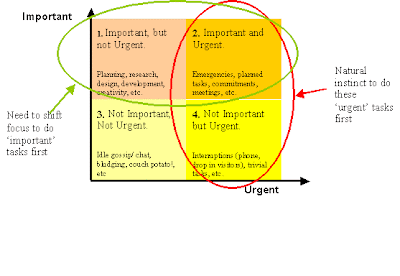
A Formula for Success0
- Lean Basics, Lean Office
- August 2, 2009
Recently, there have been a number of posts on various visual scheduling boards like Jon Miller’s agile kanban board or Xaiver’s kanban boards for example. With all these visual task ques it makes me wonder how we prioritize. There are several prioritization tools you can use to prioritize your day-to-day tasks and goal specific action
READ MORE